






For employers · Applied research
Frontier R&D, without building your own lab.
Most organisations have research problems but no research team. Outsource them to NOUSIA: feasibility, research, prototype, testing and handover.

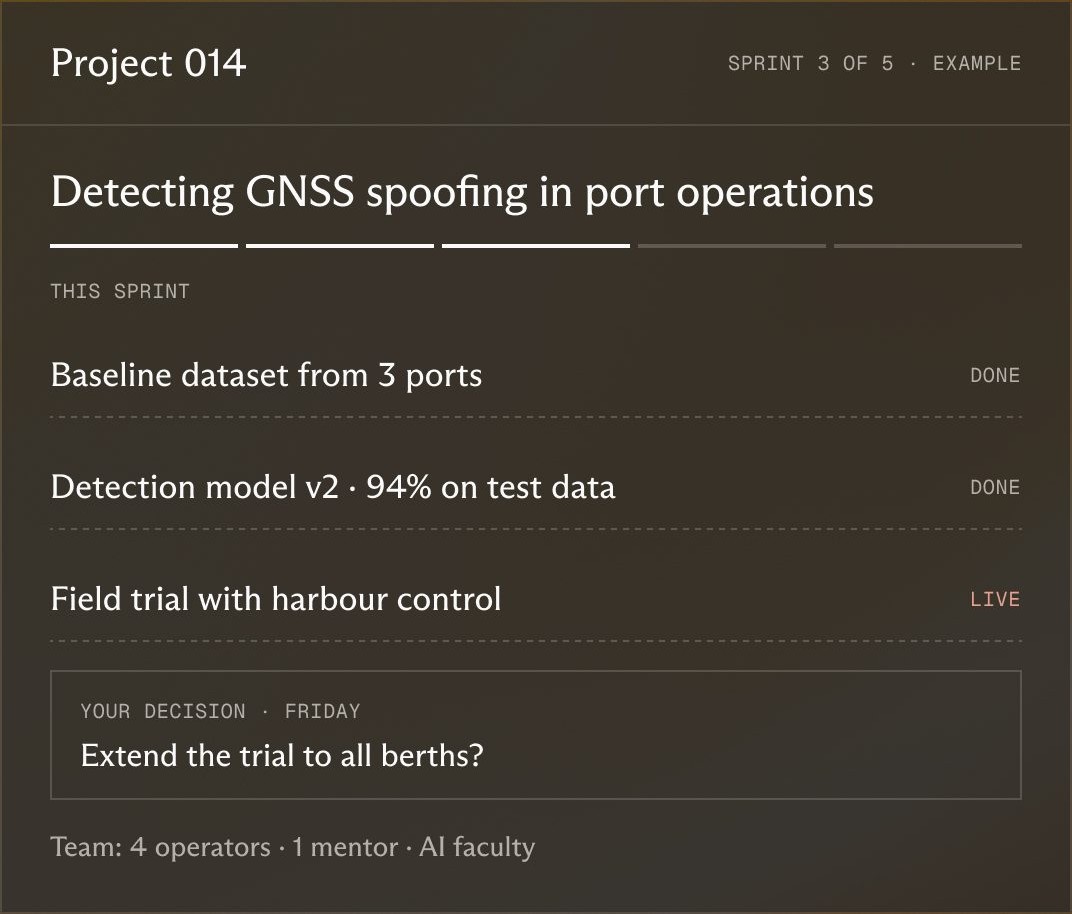
Project 014 · Sprint 3 of 5 · Example
Detecting GNSS spoofing in port operations
Prototype v2: 94% detection on test data · Field trial next
Most organisations have research problems, not research teams.
Building a lab takes years and a balance sheet most firms don’t have. So hard problems sit in the backlog, or go to partners who weren’t built for them.
1.68%
Australia’s total R&D spend as a share of GDP, against an OECD average of 2.7%.
¹ Parliamentary Library · 2024
~1%
Industry’s share of Australia’s research output, less than half that of Japan, the UK or Germany.
² Innovative Research Universities · 2025
Problem 01
No lab, but lab-sized problems
Most firms, and almost every SME, can’t justify a permanent research team for problems that arrive in bursts.
Problem 02
Nowhere obvious to send them
In Germany, a mid‑sized firm calls a Fraunhofer institute. Australia has no equivalent at that scale.³
Problem 03
Universities run on academic time
Grants, ethics approvals and IP negotiations can take months before the work starts.
Problem 04
Consultants leave with the knowledge
You get a report. When the engagement ends, the capability walks out with it.
Problem 05
Your experts are keeping the lights on
The people who could solve it are needed for day-to-day operations.
Problem 06
Sensitive problems can’t go offshore
Defence, security and critical infrastructure work needs Australian teams you can trust.
A proven model, rebuilt for the AI era.
Contract research lets any firm buy R&D by the project. We bring that model to Australia.
Germany’s Fraunhofer-Gesellschaft shows what happens when companies can contract applied research instead of building it. Its institutes turn research into results for firms of every size, including small companies with no R&D team of their own.
€3.6bn
Annual research volume
88%
From contract research
75
Institutes
Australia has no equivalent at that scale. NOUSIA brings the model here, built around AI and the people it trains. ³ Fraunhofer, Finances 2025
01
Contract research for any organisation
No lab, grant or research team needed. You bring the problem, we bring the project team.
02
AI-native from the start
AI faculty captures how elite operators reason, so projects move faster and every step is documented.
03
Research that becomes people
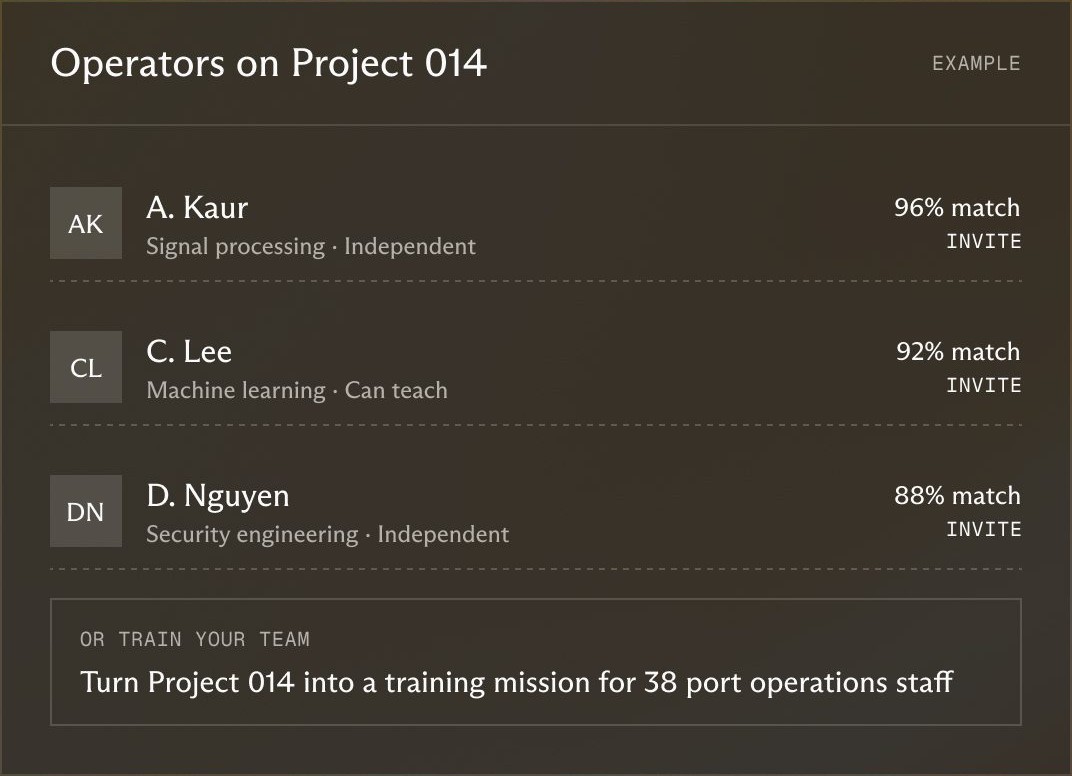
The operators who solve your problem are trained on it. Hire them, or turn the findings into training for your workforce.
From problem to prototype.
Six steps, scoped up front. Select a step to see what you get.
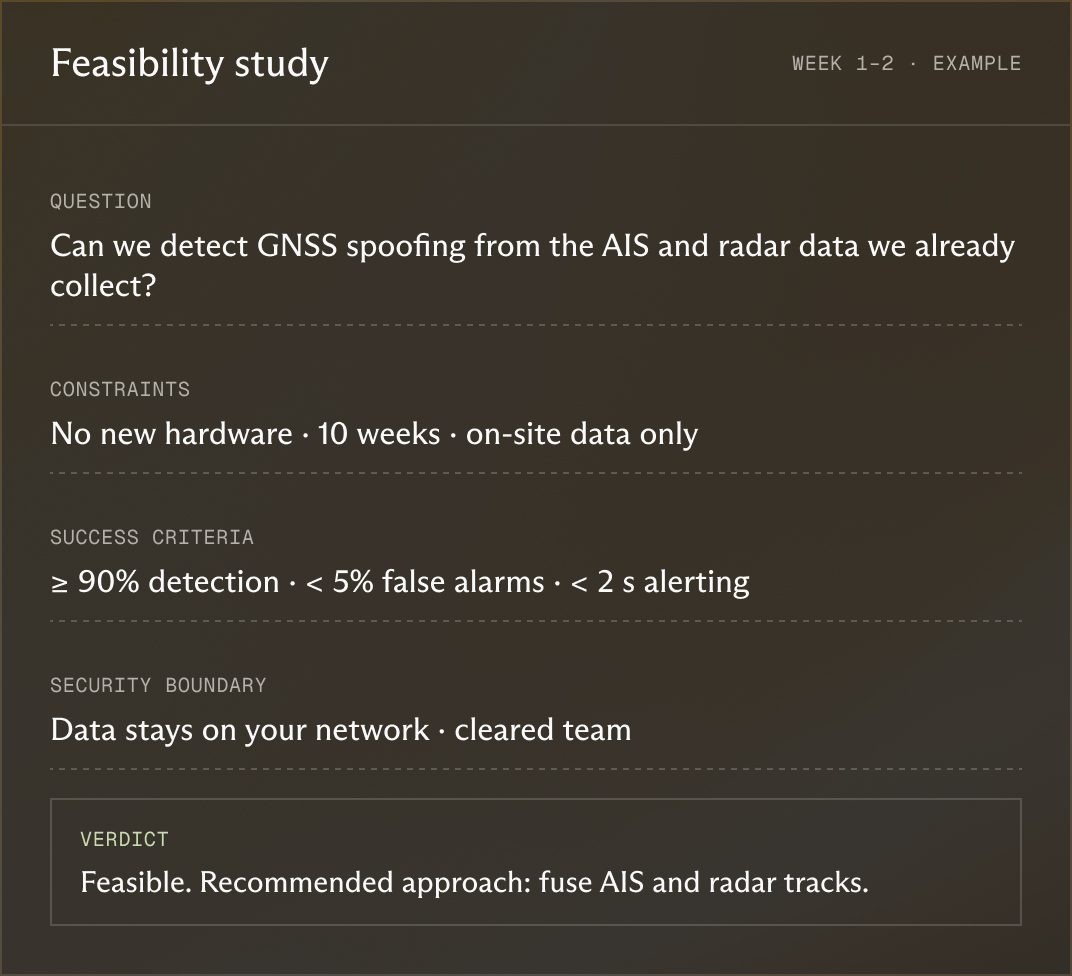
A short feasibility study turns your question into a project: constraints, success criteria and security boundary, agreed with you.
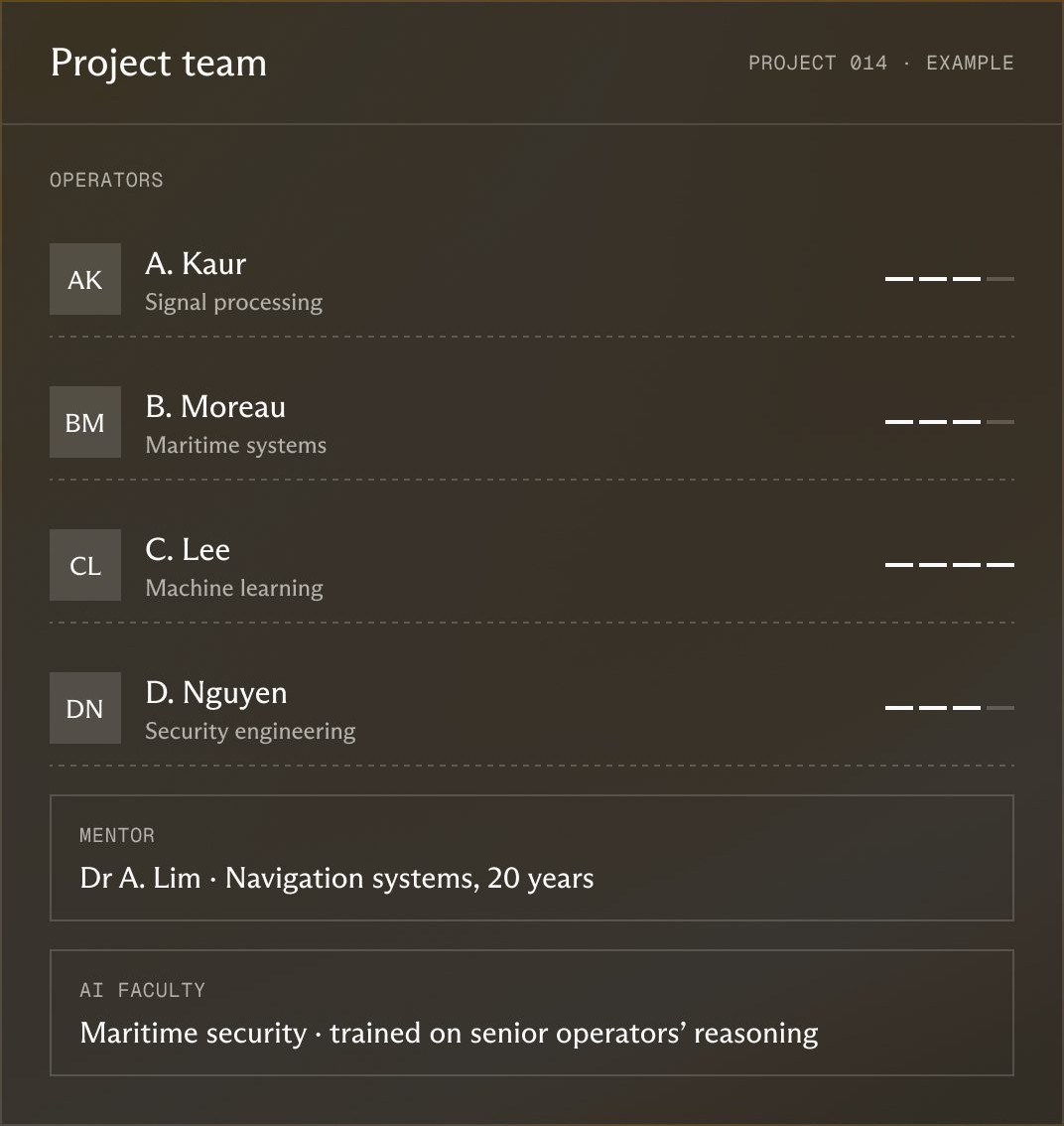
Operators matched by capability, led by mentors who have built what they’re building, supported by AI faculty.
You see hypotheses, experiments and results every sprint, not at the end. Change direction when the evidence says so.
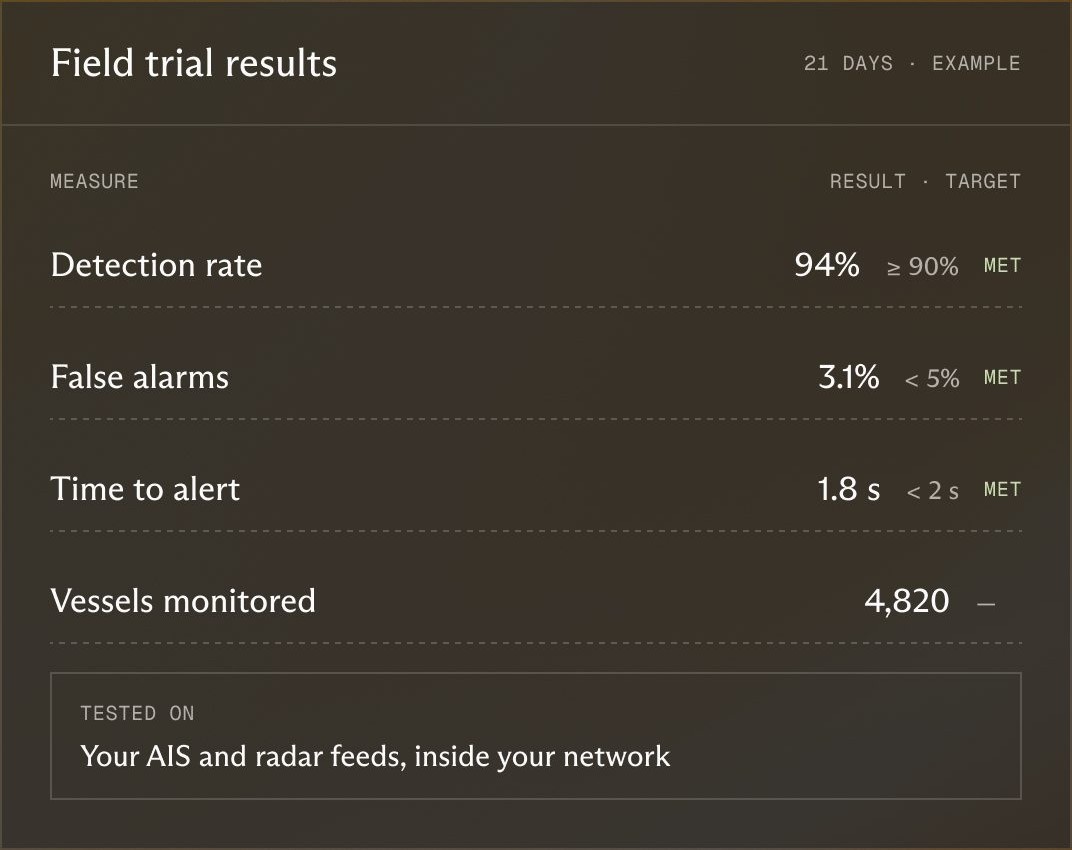
Prototypes are tested on your data and in your environment against the success criteria you set.
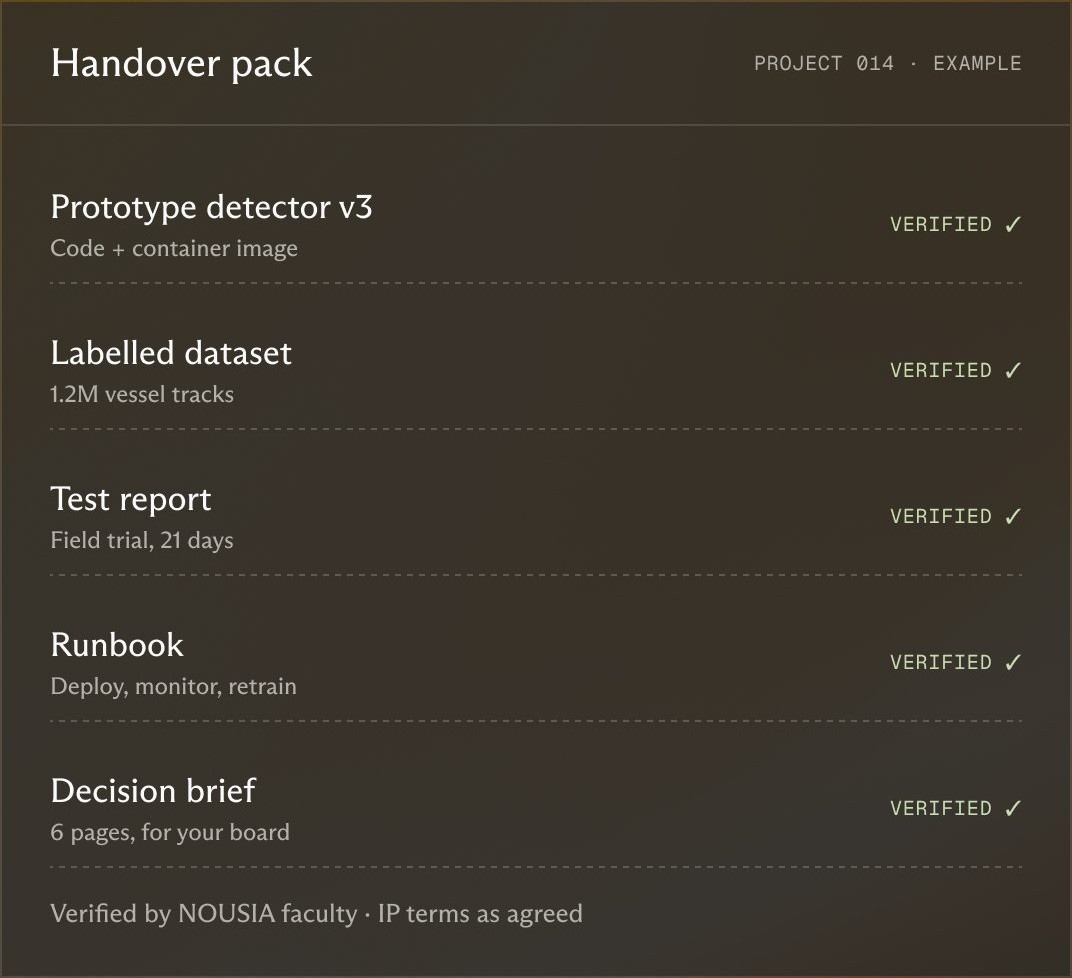
Code, data, test results and a decision-ready brief, all verified and handed over.
Hire the operators who did the work, or turn the findings into training for your team.
An R&D department, by the project.
What firms with Fraunhofer on call already get: research capacity without the overhead, sized to the problem.
Benefit 01
Pay for outcomes, not overhead
No lab, permanent headcount or grant applications. Budget per project, with scope agreed up front.
Benefit 02
Answers in weeks, not years
A feasibility study first, then short sprints with clear success criteria.
Benefit 03
A prototype you can test
Working code, models or hardware, tested on your data, not a slide deck.
Benefit 04
The team comes with it
Hire the operators who built it, already trained on your problem.
Built for organisations without a research lab.
From small firms with one hard problem to primes that need extra research capacity.
For 01
Small and mid‑sized firms
Get R&D capability without hiring a research team. Bring one problem, pay for one project.
For 02
Defence industry
Prove concepts quickly with Australian, clearance‑ready teams, from primes to their suppliers.
For 03
Critical infrastructure
Test new security and operational technology against real constraints before you commit.
For 04
Government agencies
Explore new capability before committing to a major program.
Example problem areas
Every option, compared.
How outsourcing to NOUSIA compares with the usual routes to R&D.
| University partnership | Consultancy | Build in-house | NOUSIA | |
|---|---|---|---|---|
| Time to start | Months: grants, ethics, IP | Weeks | Hire a team first | Weeks, after a feasibility study |
| Who does the work | Academics and PhD students | Consultants | Your new hires | Operators, mentors and AI faculty |
| What you get | Papers, plus IP to negotiate | A report | Depends on the team | Tested prototype and documented handover |
| Cost profile | Grant-matched | Per engagement | High and ongoing | Per project, scoped up front |
| When it ends | Researchers move on | Knowledge leaves | Team stays, and so do the costs | Hire the team or train your workforce |
| Sensitive work | Varies | Varies | In-house | Australian, clearance‑ready |
Start with one problem.
Send a one-page brief. We’ll tell you if it’s a fit and what a project would look like.
Step 01
Problem brief
Send us the problem. We come back with a feasibility view and a scoped project.
Step 02
Pilot project
One problem, a fixed timeframe and defined success criteria. Decide what’s next on the evidence.
Step 03
Research partnership
An ongoing portfolio of projects, and a pipeline of people trained on your work.
Questions about applied research
Can’t find what you need? Email contact@nousia.com.au
What kinds of problems are a good fit?
Technical or operational problems that need research, not just advice: testing feasibility, building and trialling a prototype, or proving a concept before you commit. Typical areas include cyber security, AI and autonomy, space, advanced manufacturing, energy and critical infrastructure.
We’re a small company with no R&D team. Is this for us?
Yes. It’s built for organisations without a research lab. Bring one problem and pay for one project, with scope and success criteria agreed up front.
Who owns the IP?
IP terms are agreed in the project scope before any work starts, so there’s nothing to negotiate at the end.
Can you work on classified or commercially sensitive problems?
Yes. Projects are run by Australian, clearance‑ready teams, and the security boundary is agreed with you in the feasibility study. Sensitive work stays onshore.
How long does a project take?
It depends on the problem. A short feasibility study comes first, then sprints with clear success criteria, so you see results in weeks, not years.
Who actually does the work?
Operators matched to your problem by capability, led by mentors who have built what they’re building, and supported by AI faculty.
How is quality assured?
Success criteria are agreed up front. You see hypotheses, experiments and results every sprint, prototypes are tested on your data and in your environment, and everything is verified before handover.
Can we hire the people who worked on our problem?
Yes. The operators who solve your problem are trained on it. Hire them, or turn the findings into training for your workforce.
How does pricing work?
Per project, scoped up front. You pay for outcomes, not overhead: no lab, permanent headcount or grant applications. Send a one-page brief and we’ll come back with a feasibility view and a scoped project.
Bring us the problem nobody has time for.
Send a one-page brief. We’ll tell you if it’s a fit and what a project would look like.
More ways to work with NOUSIA.

Offering 01
Verified hiring
One dedicated pipeline covering role definition, sourcing, skills assessment and a verified shortlist.
What you get
- Role and capability standard
- Sourced, assessed candidates
- Verified shortlist with evidence

Offering 02
Skills verification
Assess candidates you’ve already sourced through work samples, practical tests and evidence checks.
What you get
- Practical assessment per candidate
- Evidence-backed capability report
- Gaps made clear before you decide

Offering 03
Up-skilling
Develop existing employees against specific job requirements, with practical assessment of the resulting skills.
What you get
- Capability gap analysis
- AI readiness for every role
- Assessed, verified outcomes
Statistic footnotes
¹ Parliamentary Library, R&D and innovation in Australia: 2024 update. Gross expenditure on R&D 2021–22; OECD average 2.7%.
² Innovative Research Universities, “Australian industry not playing ball on R&D collaboration”, July 2025.
³ Fraunhofer-Gesellschaft, Finances (reporting year 2025): €3.6bn business volume, ~88% contract research. OECD, The Fraunhofer Institute, Germany: 75 institutes.